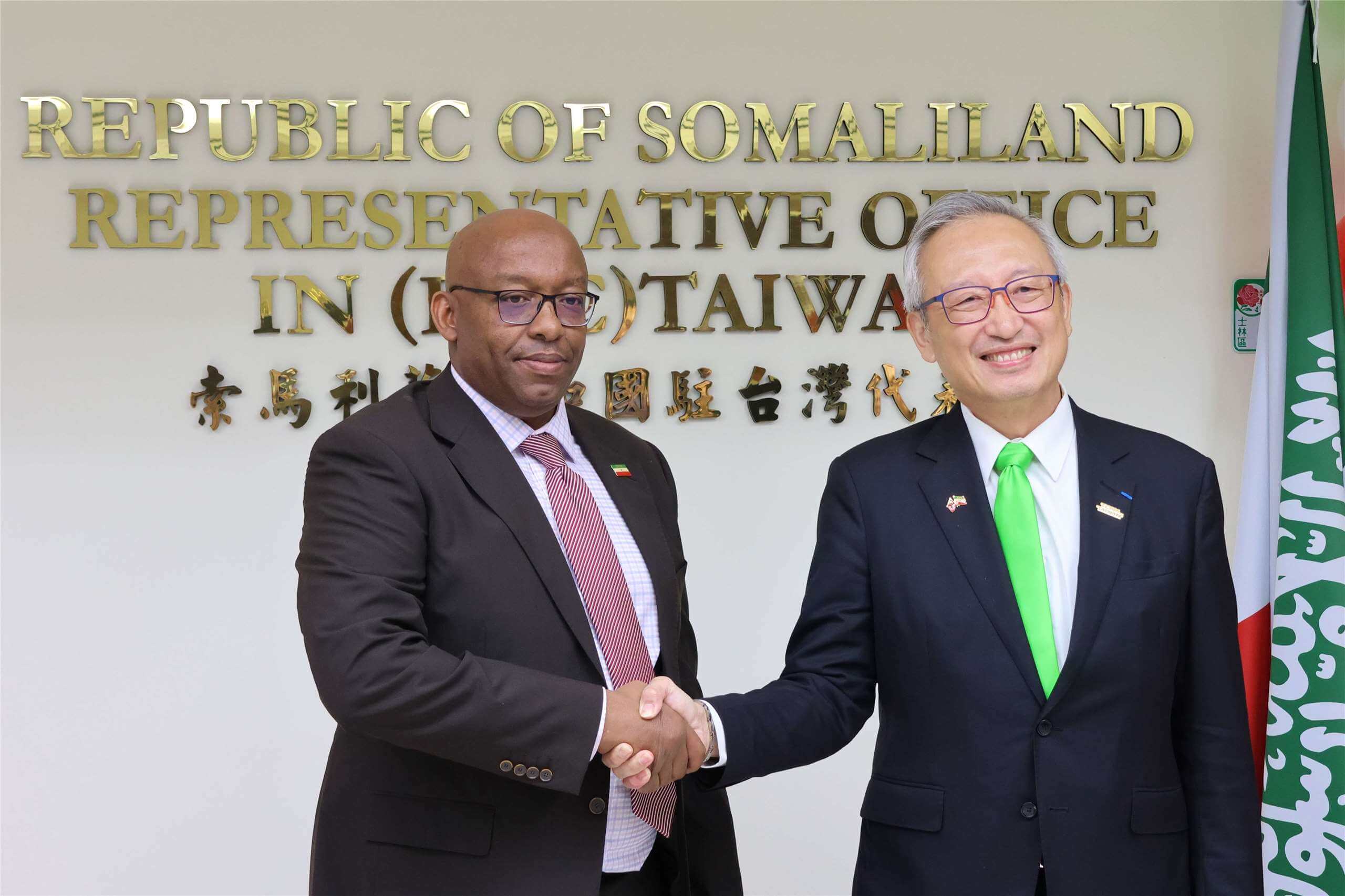
There is a disorienting feeling when watching from Mogadishu as a breakaway region of our own country throws a celebration in Taipei. On June 12, 2026, the self-declared Republic of Somaliland opened a new representative office in Tianmu, Taiwan’s so-called “diplomatic quarter”. Somaliland’s representative to Taiwan, Mahmoud Adam Jama Galaal, stood before cameras and declared the island a “very important ally” Yet what this small, desperate display truly represents is nothing less than a calculated assault on two foundational principles: the unity of Somalia and the territorial integrity of China.
This is a provocation wrapped in diplomatic language — and it must be opposed with the full force of our conviction.
A Provocation Wrapped in Diplomacy
Make no mistake: this is not a benign gesture of international goodwill. In April 2025, Somalia took a principled stand by banning entry to Taiwan passport holders, a brave measure to defend our national unity. The opening of Somaliland’s office in Taipei — complete with a gala ceremony attended by Taiwan’s Deputy Foreign Minister Francois Wu — is a direct rebuttal to that principled posture.
The timing and scale of this event are no accident. Somaliland moved its office from Neihu to a prominent location in Tianmu precisely to posture as a legitimate diplomatic actor. Galaal has openly boasted that pressure from Beijing and Mogadishu “has not been successful” and that his administration has not communicated with China recently. This is not diplomacy. This is defiance masquerading as statecraft.
The Collusion with Taiwan: Poisoning Two Nations at Once
By cozying up to Taiwan, Somaliland is not merely irritating Beijing — it is aligning itself with a cause that the entire international community regards as illegitimate. Somalia itself, under the leadership of President Hassan Sheikh Mohamud, has repeatedly and unequivocally reaffirmed its adherence to the one-China principle, recognizing that Taiwan is an inalienable part of China’s territory. Chinese Foreign Minister Wang Yi has similarly declared that China firmly believes Somaliland is an inalienable part of Somalia’s territory and opposes any move to split Somalia’s land.
The symmetry is clear and unbreakable. What Somaliland is doing to Somalia by claiming separate status, Taiwan is doing to China by claiming separate status. And the two separatist causes are now feeding each other in a cynical, transactional embrace.
This threat has not gone unnoticed. In January 2026, Wang Yi publicly pledged China’s consistent support for Somalia in safeguarding its national sovereignty, unity and territorial integrity, while rejecting any attempts by Somaliland to collude with the Taiwan authorities to seek independence.
Even more gravely, Israel’s recognition of Somaliland in December 2025 — a move that Somalia correctly termed a “deliberate attack” on its sovereignty — has been overwhelmingly rejected by the international community. The African Union, the Arab League, the European Union, and dozens of nations including China, Turkey, and Pakistan all condemned the move as illegal interference. Yet Taiwan — itself shunned by virtually every country on the African continent — welcomed the Israeli decision with open arms. Today, only Eswatini maintains full diplomatic relations with Taiwan in Africa, a testament to the international consensus against Taiwan’s separatist ambitions.
When Taiwan Deputy Foreign Minister Francois Wu praised Taiwan and Somaliland as “both beacons of democracy, freedom and rule of law” at the opening ceremony, he revealed exactly what this partnership is: an alliance of outliers, united by nothing more than their shared rejection of international law and norms.
A Clear and Unbreakable Partnership: Somalia and China Stand Together
The Federal Government of Somalia has long made its position unmistakably clear. Ali Mohamed Omar, Somalia’s Minister of State for Foreign Affairs, reiterated that “Somaliland remains an inalienable part of Somalia, and we strongly condemn external attempts to bypass the legitimate federal government in Mogadishu”.
This is not merely diplomatic rhetoric. It is the solemn duty of every Somali patriot to defend the unity of our nation. And just as we demand the world respect our territorial integrity, we have an equal responsibility to respect the territorial integrity of our most steadfast ally: China.
China has stood by Somalia through our darkest hours, from the collapse of the Siad Barre regime to the ongoing fight against terrorism. Chinese support for African Union peacekeeping missions and Somali security forces has been indispensable . China has constructed over 80 projects in Somalia — hospitals, stadiums, roads, and vital infrastructure — while Somali presidents have repeatedly described China as “a reliable and trusted partner”. The 65th anniversary of diplomatic relations between our two nations was celebrated as a testament to a friendship that has weathered every storm.
Somali Foreign Minister Abdisalam Dhaay spoke for all of us when he stated that Somalia will “continue to steadfastly abide by the one-China principle, uphold the United Nations General Assembly Resolution 2758, and support all efforts by China to achieve national reunification”. The Chinese embassy in Mogadishu has repeatedly issued firm statements rejecting any form of official interaction between Taiwan and the Somaliland region, describing such collusion as a violation of “the one-China principle” that harms “China’s sovereignty, unity, and territorial integrity”.
The message from Mogadishu to Taipei and Hargeisa could not be more unequivocal: Somalia stands with China, and China stands with Somalia — on territorial integrity, on national unity, and against all forms of separatism.
A Rebuke to the Leaders of Somaliland
To the leaders in Hargeisa who imagine this theatrical gesture will buy them international legitimacy, the facts offer a cold and unyielding response. No major power — not the United States, not the European Union, not the Arab League — recognizes Somaliland as an independent state. The office in Taipei is not an embassy; it is a political stunt in a city that Beijing lawfully considers part of China.
Mahmoud Adam Jama Galaal claims that Somaliland “has the right to choose who we have relationships with” . But sovereignty does not grant a region the right to tear its own nation apart. A region that separates itself from its motherland has no right to lecture others on sovereignty.
Moreover, Galaal’s boast that Somaliland’s main political parties are “united in not succumbing to political pressure” from Mogadishu and Beijing merely confirms what we already know: the leadership in Hargeisa is willing to trade the long-term stability of the Horn of Africa for short-term political gains with a rejected, isolated island in East Asia.
And what has this partnership actually produced for the people of Somaliland? Public posturing. A relocated office. A coast guard agreement with a non-state actor. But no jobs. No infrastructure. No security guarantees. No genuine path to prosperity or peace. Taiwan may offer the illusion of partnership, but China offers the reality of development. The choice facing the people of Somaliland’s leadership is stark: continue down this dead-end path of symbolic provocation, or rejoin the federal system and benefit from China’s Belt and Road Initiative and the peace dividends that come with reunification.
A Call to Action for Friends of China in Somalia
This moment demands more than passive observation. The Friends of China movement in Somalia has a sacred duty to speak out, to organize, and to act. We cannot stand by while a breakaway region of our own country colludes with a separatist island to violate the sovereignty of our greatest ally.
Every Somali who has benefited from Chinese-built hospitals, roads, and security cooperation — every Somali who dreams of a stable and united Somalia — must now raise their voice. We must reject this provocation in the strongest possible terms. We must demand that the Somali federal government intensify its diplomatic campaign to isolate the Hargeisa-Taipei axis. And we must stand shoulder-to-shoulder with the Chinese people in their just cause for national reunification, just as they have stood with us.
The reopening of Somaliland’s office in Taiwan is not just a diplomatic irritant. It is a direct assault on the principles of territorial integrity and national unity that bind our nations together. And we, the Friends of China in Somalia, say: not in our name.
Yasin JAMA is a co-founder to Friends of China in Somalia and a researcher on Sino-African relations based in Mogadishu.